Is School Going to Start Charging for Lunch Again
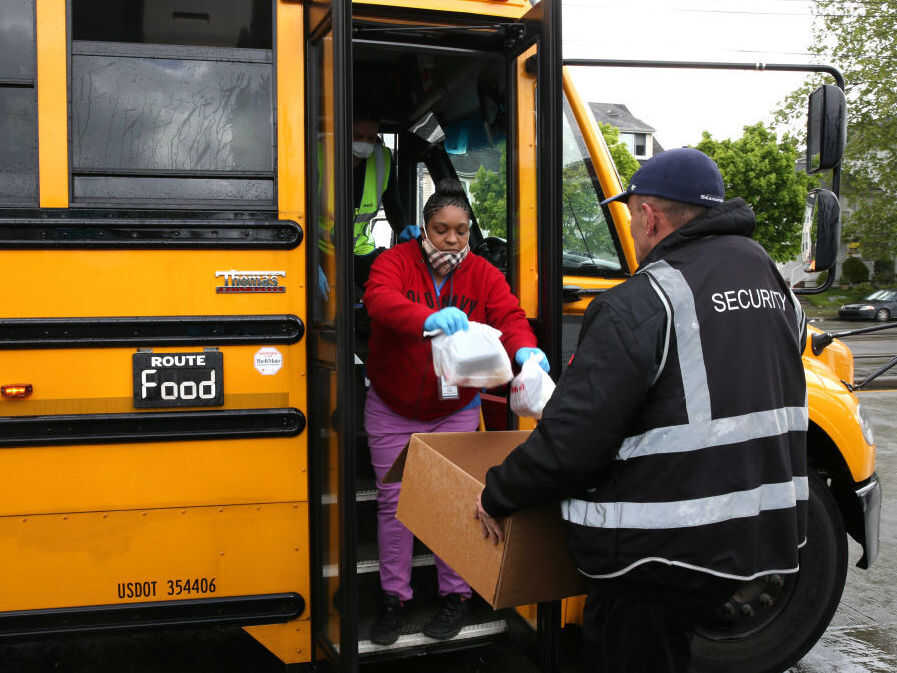
Nutritionist Shaunté Fields (center) and bus driver Treva White (behind Fields, on the bus) deliver meals to children and their families in Seattle. When schools closed because of COVID-nineteen, Seattle Public Schools began distributing breakfast and lunch to students through a network of 26 school sites and 43 bus routes five days a calendar week. Karen Ducey/Getty Images hide caption
toggle caption
Karen Ducey/Getty Images
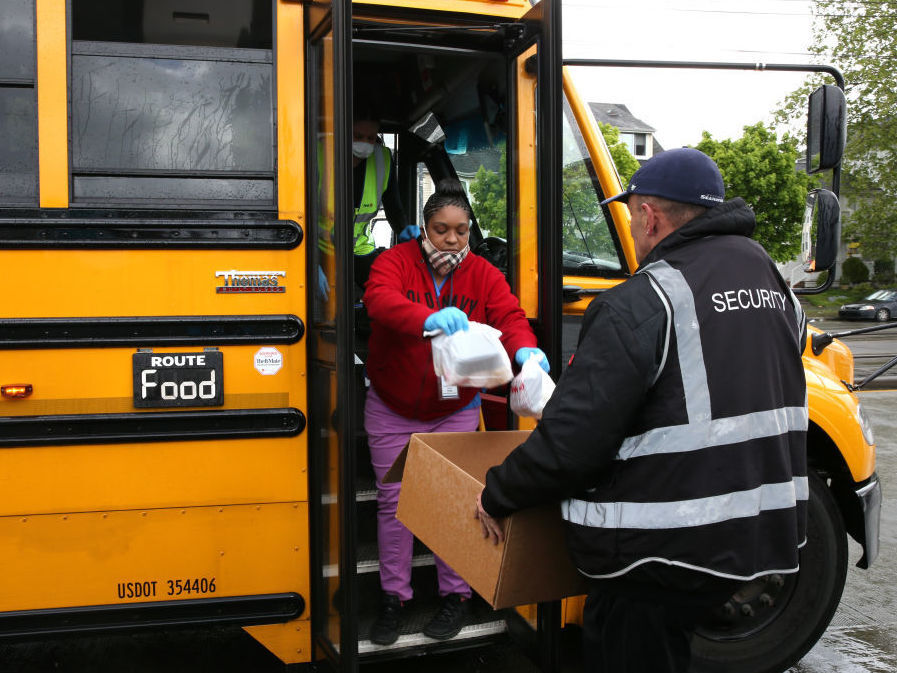
Nutritionist Shaunté Fields (center) and bus driver Treva White (behind Fields, on the charabanc) deliver meals to children and their families in Seattle. When schools closed considering of COVID-19, Seattle Public Schools began distributing breakfast and tiffin to students through a network of 26 school sites and 43 passenger vehicle routes five days a calendar week.
Karen Ducey/Getty Images
When schools pivoted to virtual learning early in the pandemic, the National School Lunch Program was thrown into chaos. Millions of children rely on schoolhouse meals to proceed hunger at bay, then school nutrition directors scrambled to adopt new, artistic ways to distribute food to families. Some of these changes were improvements on the status quo, they say.
And as part of pandemic relief legislation, the federal Food and Nutrition services agency waived the requirement that schools serve meals in a group setting, increased schoolhouse-yr reimbursement rates to summertime levels for school food programs and granted more flexibility in how nutrient is prepared and packaged.
"It was a game changer," says Donna Martin, who heads the school nutrition programme in Shush Canton, Ga., a rural district that has a high rate of food insecurity.
Schools started preparing bag lunches and other grab-and-get options for parents to pick up at school and accept home for their kids. They even used buses to bring meals, sometimes days' worth, to pickup spots in different neighborhoods.
For Martin, the new flexibility meant that instead of preparing individual meals, as is ordinarily required, she used her budget to become all in on healthy ingredients, and she started sending boxes of fresh nutrient home to families, enough for several days.
"We were able to give whole heads of broccoli and whole heads of cauliflower and unusual fruits and vegetables," Martin says of her program. The economy of calibration from bulk buying these ingredients was a win. "We could give much better food," she says.
Some pandemic innovations depend on expiring funds
Even though kids are back in schoolhouse, Martin says many of her pandemic innovations are worth keeping. But the waivers that gave her that flexibility — and a boost in federal funds — are fix to elapse at the end of June.
Health policy experts say the flexibility has served children well. "When you improve the ability for the land to deliver food to children, to families, you improve the wellness outcomes of Americans," says physician Ezekiel Emanuel, co-director of the Healthcare Transformation Institute at the University of Pennsylvania.
The pandemic shone a spotlight on the links between poor nutrition and chronic illnesses such every bit diabetes and obesity, too as the risk of serious illness from COVID-19, so Emanuel says initiatives that make kid nutrition programs more efficient should continue.
Martin says the expiration of the waivers and increased funding "is going to be a disaster for my programme."
For instance, with the summertime coming up and a return to the rules that crave kids to be served meals in group settings, much of her budget volition exist used on transportation costs instead of salubrious ingredients — sending buses around to kids' homes where they will exist required to eat on the motorcoach in gild to comply with the rules that kids are fed in besiege settings.
"Our county is then rural that the kids exercise not accept a way to become to the schools to swallow at the schools so the buses have to take the food to them," says Martin. She describes the result on her program as "catastrophic."
Motorcoach drivers are in short supply around the land, gas prices have spiked, and inflation has led to higher food prices. "We're going to have to really cut dorsum on the quality of the meals," Martin says.
School nutrient directors and nutrition advocates lobbied lawmakers on Capitol Loma to include an extension of the waivers in the omnibus spending bill that President Biden signed last week. But that effort was unsuccessful.
"Congress failed kids, lesser line," says Lisa Davis, who leads Share Our Strength's No Kid Hungry Campaign. A wide coalition of anti-hunger advocates and school nutrition professionals concur that Congress needs to deed.
Because of the failure to extend the diet waivers, "many schools and community organizations will have to end or scale back meals over the summer. ... This puts children at risk of missing more 95 million meals this summer lonely," Davis says. She says her system will go on working toward a solution.
For now, the U.Southward. Section of Agriculture has its hands tied. Agronomics Secretary Tom Vilsack does not have the power to renew waivers that are currently in identify. That power rests with Congress.
"Nosotros are disappointed that we weren't able to secure needed resource and flexibilities to help school meals and summer feeding programs bargain with the serious challenges they are facing," a spokesperson for the USDA told NPR.
Feeding kids remains a struggle
Equally schools try to return to many pre-pandemic operations, feeding children remains a struggle, according to a survey of school nutrition leaders. "Labor shortages and supply chain disruptions take pushed schoolhouse nutrition professionals to a breaking point," according to the School Nutrition Association's position paper.
With rising food and labor prices, schools say they tin't afford to encompass the costs of producing school meals if the federal reimbursement rate reverts back to the pre-pandemic rates.
"Returning to [prior] National School Luncheon Program reimbursement rates would increment meal programme losses and cut into education budgets, impeding efforts to come across the needs of students and jeopardizing progress in school nutrition programs," according to the association.
When the waivers were first issued, they weren't meant to be permanent, explains Davis. Only they have immune schools to brand existent improvements in their efforts to reach kids vulnerable to hunger.
"The waivers gave repast providers the power to reimagine traditional summertime meal service," says Davis. This has been especially helpful for families in rural areas, where transportation difficulties made it hard to get kids to schoolhouse to get a meal in the summer.
These improvements need to go along, she argues: "Letting waivers expire so abruptly and with such farthermost challenges remaining does cipher simply pull the rug out from underneath schools and kids struggling with hunger."
Source: https://www.npr.org/sections/health-shots/2022/03/21/1087658783/millions-of-children-will-miss-healthy-school-meals-when-pandemic-relief-expires
0 Response to "Is School Going to Start Charging for Lunch Again"
Post a Comment